

Buying or selling a condo involves much more than a contract. Deadlines, documents, approvals, and fees all have to line up, and every person in the transaction depends on someone else to keep it moving. That is why this conversation mattered.
On Thursday, November 12, 2026, the Brickell Homeowners Association welcomed condominium board leaders, property managers, and real estate professionals to a BHA Lunch & Learn: Boards, Brokers & Buyers, Navigating Real Estate Transactions in Community Associations. It brought the people on every side of a sale around one table.
Hanniel Pina moderated the discussion. Our panelists were Katherine Arteta of LUXE Properties, Carmen Cruz of Castle Group, and Roberto Blanch of Siegfried Rivera. Thank you for sharing your time and your practical, real-world experience with our community. Thank you to our sponsors, Siegfried Rivera and Castle Group, for supporting this Lunch & Learn.
Start the Conversation Early
The first theme of the afternoon was simple: do not wait until a contract is signed to figure out the process.
Governing documents are among the records associations submit to Miami-Dade County's Community Association Registry, yet some managers still hesitate to release them to a realtor because they are unsure who has authorized it. The panel's advice was to settle that question ahead of time.
Talk with your board and your unit owners, then adopt a clear policy for when a unit is being bought or sold in your building.
A quick introduction goes a long way, too. Agents who introduce themselves to the property manager before a listing goes live usually find that the process runs through a single point of contact and a much smoother exchange of information.
From Listing to Closing
Before Listing
The board sets the document-sharing policy after discussing it with the property manager and unit owners.
Before Going Live
The listing agent contacts the property manager before the listing goes live and confirms who will handle document requests.
At Contract Execution
The seller, with help from the listing agent, requests the full document set from the association in one email and provides it to the buyer.
Before Closing
The buyer completes the application and confirms financing with the lender. The buyer and seller review assessments with their agents or attorneys. The board handles any required association approval.
Know the Clocks That Are Running
Time is the thread that runs through every transaction. A few reminders from the panel:
- When an owner makes a written request for governing documents, Florida Statutes section 718.111(12)(b) and (c) requires the association to make the records available within 10 working days. For a willful failure to provide access, an owner may recover actual damages or minimum damages of $50 per calendar day for up to 10 days, starting on the 11th working day after the request is received.
- For a resale by a nondeveloper owner, Florida Statutes section 718.503(2) provides a 7-day cancellation period, excluding Saturdays, Sundays, and legal holidays, after the buyer signs the contract and receives the required documents. Cancellation requires written notice, and this right ends at closing. If documents arrive late, a buyer can have second thoughts well into the contract period.
- The clock starts when the request comes in. Every call between the attorney, the realtor, and the manager uses up time, so send documents as soon as the contract is executed and ask for everything in a single email.
A Complete Application Protects Everyone
The checklist is short, but each item can be complex: signatures, the application, lending documents, the governing documents, and any questionnaires. A gap in any one of them can delay closing, and that frustrates the buyer, the seller, and the board.
The panel also reminded managers to know their documents, including whether the association has a right of refusal. It is easy to overlook, and it can add an unexpected step to an otherwise routine sale.
Estoppel Certificates: Authority, Timing, and Content
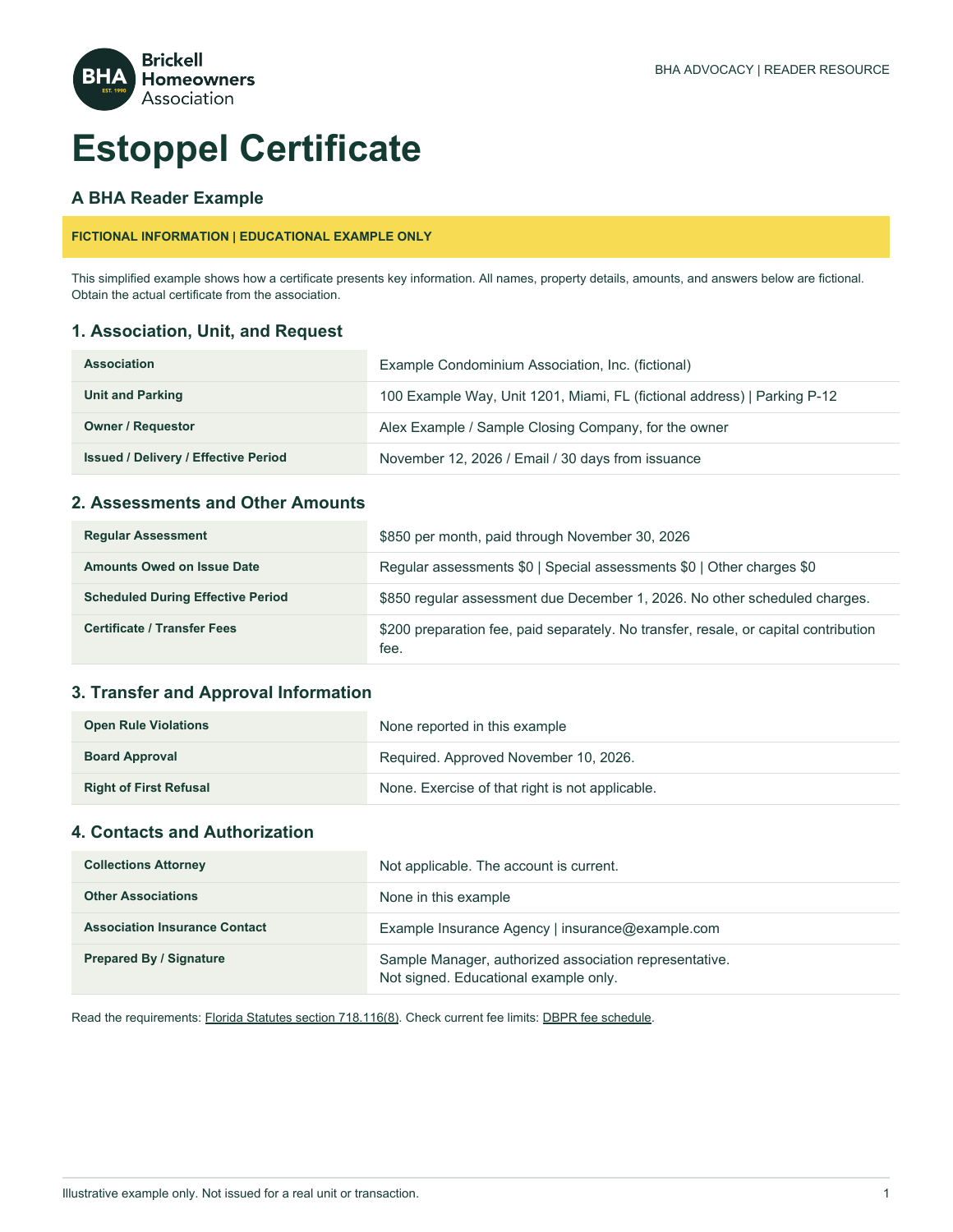
An estoppel certificate is a written statement from the condominium association showing a unit's regular dues, special assessments, and other amounts owed, along with certain transfer and approval details. It helps the buyer and closing team understand what is owed before the sale closes.
Estoppel certificates are more detailed than ever since the statute was updated. The key points we heard:
- Under Florida Statutes section 718.116(8)(h), authority to charge for an estoppel certificate must be established by a written board resolution or a written management, bookkeeping, or maintenance contract.
- The association has 10 business days to provide the certificate.
- Fees are capped and periodically adjusted. The current DBPR fee schedule (PDF) permits up to $299 for a standard certificate, an additional $119 for delivery within 3 business days when expedited service is requested, and up to an additional $179 if the account is delinquent.
- The certificate has to do more than state a balance. It must also include the information the statute requires, including identifying the association.
Boards and managers should confirm current amounts and requirements with their association attorney before relying on any figure.
For background on the 2017 changes, read Siegfried Rivera's explanation of association estoppel certificates.
Assessments Are Part of the Picture
Assessments are becoming more common. Structural Integrity Reserve Studies, reserve funding, milestone inspections, and communications upgrades for first responders are all arriving at the same time, and many associations are choosing longer-term special assessments to ease the burden on owners.
For sellers and buyers, the takeaway is to read the minutes. Some assessment packages include due-on-sale provisions, which means a unit's share may come due when the unit is sold. The contract should address it clearly, and buyers should go in knowing that an assessment at some point is likely.
Financing and the Fannie Mae Reserve Standard
The panel explained that Fannie Mae's reserve guideline is moving from 10 percent toward 15 percent, and that buildings not meeting the criteria can appear on a list of non-compliant condominiums in South Florida. Boards can check whether their building is on it and work to meet the criteria.
We also heard that FHA spot approvals are becoming more common when a building's financials are healthy. The panel was careful to say this is not the norm, and that it is the association's choice and responsibility to pursue approval.
Approvals Should Be Fair and Well Documented
Boards and managers should be trained to avoid anything discriminatory. The panel also cautioned that some boards assume they can approve or reject any applicant, and then react strongly to a background check or a credit score. Where an association has a right of refusal, rejecting a buyer can require the association itself to purchase the unit, and that requires a unit owner vote, which is difficult to achieve. A rejection generally has to rest on a material misrepresentation in the application, and a judge ultimately decides what is material.
The lesson: apply your documents carefully, apply them consistently, and talk to your association attorney before denying an applicant.
Use the Resources Already Available
The seller, or the listing agent acting with the seller's authorization, can request copies of the association's governing documents, budget, and financial statements for the buyer to review.
Before making that request, they can search the Miami-Dade County Community Association Registry at miamidade.gov by association name or address. Associations submit governing documents, budgets, and financial statements to the county. Use the portal's public records request link to obtain documents, and check with the association for any missing or updated records. Board members are also unit owners, so these conversations help them when it is their turn to sell.
Practical Steps for Your Next Condo Sale
- Boards should adopt a document-sharing policy with input from property managers and unit owners before a sale begins.
- Listing agents should introduce themselves to the property manager before the listing goes live.
- Buyers, sellers, their agents, and property managers should identify the deadlines that apply to their part of the transaction and track them from the start.
- Boards and property managers should confirm the association’s authority to charge estoppel fees, the applicable fee limits, and any right of refusal with the association’s attorney.
- Buyers and sellers should review meeting minutes for assessments with their agents or attorneys.
- Boards should make fair, consistent approval decisions, and property managers should help document the process.
Thank you to our panelists, our guests, and everyone who made time to join us. BHA will keep creating opportunities for boards, managers, and professionals to learn from one another. Have a topic you would like us to cover next? Email us at info@brickellhomeowners.org and we will work with our Associate Members to help meet your community's educational needs.
If this recap was helpful, please share it with a board member or property manager in your building.






Thank You to Our Sponsors